Eugene Perry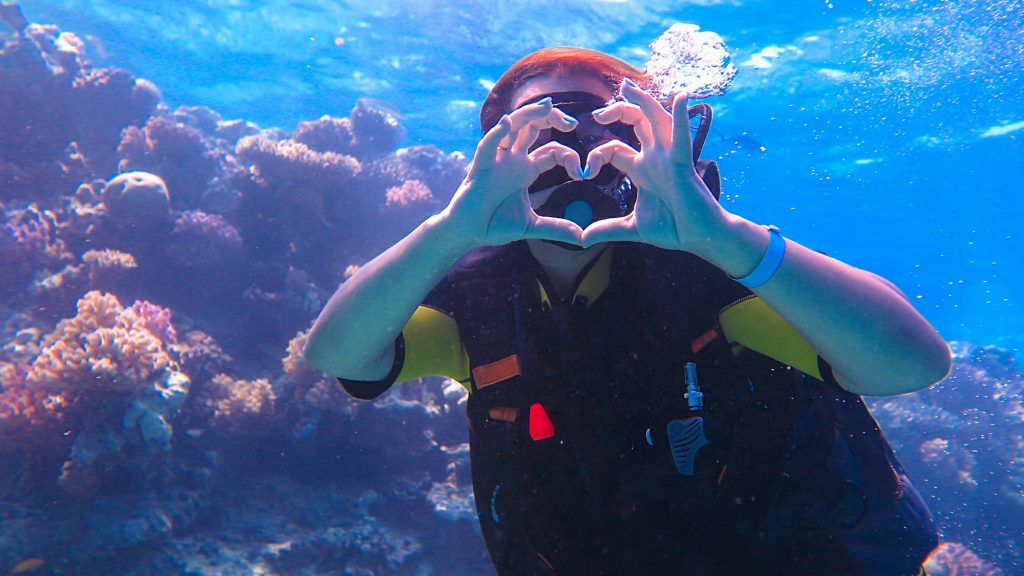
A girl in scuba diving near a sea reef, shows a heart with her hands
Scuba Diving is an engaging, thrilling, and challenging sport with numerous health advantages. It can provide a respite from everyday routine, give divers an opportunity to see stunning marine life up close, explore nearby environments, as well as offering therapeutic healing properties of water itself – it creates weightlessness that allows the body to unwind and relax while increasing oxygen flow and releasing serotonin – giving an overall sense of happiness and wellbeing.
Scuba diving builds confidence and self-esteem. Mastering underwater skills and conquering challenges helps build self-assurance that can translate to other areas of your life.
Scuba diving exercise helps to enhance overall health by strengthening and toning muscles in your arms, legs, chest, abdomen and posture. Furthermore, deep and slow breathing provides mental relaxation to help combat depression.
Learning more about ocean ecology can expand your appreciation of Earth and all its inhabitants while inspiring you to take actions to preserve it – particularly through participation in underwater cleanups or conservation initiatives.
Social Benefits
Scuba diving can be an incredible way to meet new friends who share your love of the ocean and its creatures. From joining dive clubs or meeting at local dive shops for dive planning sessions and trips, volunteering together at underwater cleanup events or diving together on trips – diving is an invaluable way of meeting like-minded individuals with whom you share dive boats or sites; buddy diving teaches valuable life lessons while building trust among diving partners as you are completely dependent upon each other when underwater.
Being up close and personal with marine wildlife like sharks, dolphins or whales can have a transformative effect on our mood and emotions. Many people create “wish lists” of marine life they hope to witness before passing away; ticking off these animals gives great satisfaction.
Safety Scuba Diving can be an extremely safe sport when performed under the guidance of a PADI-certified instructor. As part of your training you’ll learn to correctly setup and use your equipment, how to handle emergencies (like losing air supply or dislodging your mask accidentally), navigate using maps and compasses as well as monitor gas usage with buddy systems for safe ascend or descend times.
Scuba diving experiments began in the 1940s, while modern diving gear didn’t become widely available until about 1950. Jacques Cousteau created an Aqua-Lung that enabled divers to remain underwater for extended periods and explore ocean depths without surface breathing; his books, films, and television shows popularized this form of aquatic exploration. NAUI and PADI training agencies also formed shortly thereafter in order to train and certify divers; NAUI in 1960 while PADI in 1966 respectively.